The Contract Was Signed Three Years Ago and Nobody Can Find the Clause: What private AI can do for Northern Ireland construction firms, quantity surveyors and project managers buried under contracts, variations and compliance documents they cannot search fast enough
Every variation, every defect notice, every subcontractor agreement is in there somewhere. The problem is finding it before the dispute does. Northern Ireland construction businesses are sitting on years of project documentation and most of it is completely unsearchable.
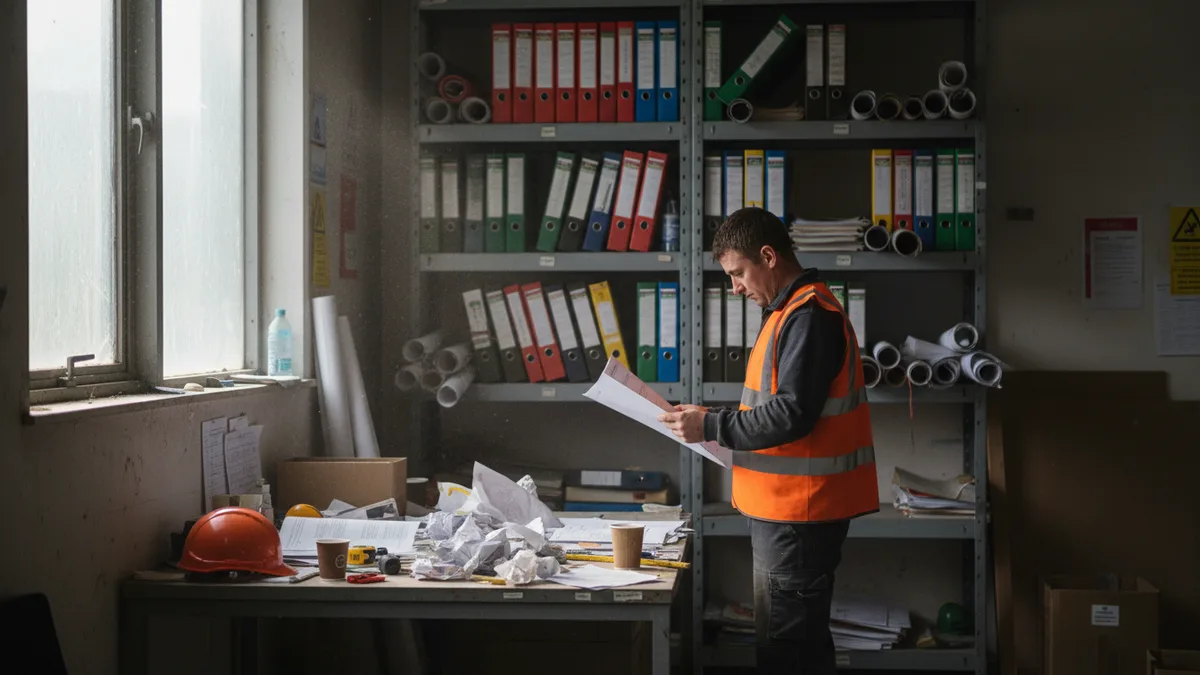
There is a particular kind of frustration that anyone who has worked on a construction project in Northern Ireland will recognise. A subcontractor raises a query about a variation from eight months ago. A client disputes a defect liability period. A site manager needs to check what the spec actually says about a particular material. And somewhere, in a shared drive or a filing cabinet or an email thread from two project managers ago, the answer exists. It just takes forty minutes to find it, if it gets found at all.
That is not a technology problem in the way most people mean the phrase. The documents are there. The information was captured. The problem is that it was captured in a format that nobody can search properly: scanned PDFs, Word documents with inconsistent naming conventions, email attachments spread across three inboxes, handwritten site instructions that got photographed and filed under the wrong job number. Construction businesses in Northern Ireland are not short of documentation. They are short of a way to get answers out of it quickly.
What actually goes wrong and when
The pressure points are almost always the same. Tender stage, when someone needs to pull together information from previous similar projects and ends up recreating it from scratch because the last project files are impenetrable. Variation management, when a change gets agreed verbally on site and the paperwork catches up weeks later, if it catches up at all. Defects periods, when a client raises something and the site team has to trawl back through inspection records, handover documents and email chains to establish what was signed off and when. And disputes, which in construction can arrive years after practical completion and require you to reconstruct a complete picture from documentation that was never designed to tell a coherent story.
None of these are unusual situations. They happen on jobs in Belfast, Derry, Newry and Antrim every week. And the cost is not just the time spent searching. It is the decisions made without the full picture, the variations that slip through without proper records, the claims that are harder to defend because the evidence is technically present but practically inaccessible.
Why construction documentation is particularly hard to manage
Most sectors have messy data. Construction has messy data with unusually high stakes attached to it. A contract clause, a programme note, a drawing revision, a site instruction: any one of these can become the centre of a six-figure dispute. The document management problem is not just an efficiency issue. It is a commercial risk.
The other complication is that construction projects generate documents from multiple sources simultaneously. The client produces documents. The design team produces documents. Subcontractors produce documents. The main contractor produces documents. Most of these arrive in different formats, with different naming conventions, through different channels. By the time a project is finished, the file for a medium-sized commercial fit-out in Belfast city centre might contain several thousand individual documents. Nobody sat down and organised them into a searchable structure as they came in. There was never time for that.
And then there is the human turnover. Project managers move on. Site managers change. The person who knew where everything was filed leaves, and what they carried in their head goes with them.
Why this matters specifically for Northern Ireland
The Northern Ireland construction sector is dominated by SMEs. There are a handful of large contractors, but the bulk of the industry is made up of medium-sized main contractors, specialist subcontractors, quantity surveying practices and project management consultancies with teams of ten to fifty people. These businesses do not have the resources to build bespoke document management systems from scratch or to employ a full-time information manager on every project.
They also operate in a procurement environment that has its own particular pressures. Public sector work, which accounts for a significant share of construction activity here, comes with compliance requirements around documentation, audit trails and record-keeping that are not getting lighter. The Construction Contracts Act applies in Northern Ireland, which means adjudication is a real possibility on almost any commercial project. Having your documentation in order is not a nice-to-have. It is a basic commercial protection.
There is also a practical reality about the talent market. Good project managers and quantity surveyors in Northern Ireland are in short supply. When they spend a meaningful part of their week hunting through files rather than doing the work that actually requires their judgement, that is a waste that most businesses cannot afford.
What private AI can actually do here
The application that makes the most immediate difference for construction businesses is document and knowledge search. A private AI system, installed inside your business and connected to the file stores, shared drives and email archives you already have, can let a project manager type a plain-English question and get a specific answer drawn from the actual project documentation, with a reference to the source document so they can check it themselves.
That sounds simple. The practical effect is not. Instead of forty minutes searching a shared drive, a site manager can ask which drawing revision was current at the time of a particular inspection and get an answer in thirty seconds. A QS can ask what the contract says about the notice period for claiming loss and expense on this specific job and read the relevant clause directly. A director can ask whether any subcontractor on a current project has an insurance certificate expiring in the next sixty days and get a list.
The critical point is that none of this involves sending your contract data to a public AI tool. A private system runs on your own infrastructure, whether that is a server in your office, a private cloud environment, or a hybrid of both. Your commercial data, your client names, your contract terms, your pricing, your claims history: none of it leaves your control and none of it is used to train a model that anyone else benefits from. For a sector where confidentiality and commercial sensitivity are fundamental, that distinction matters enormously.
Beyond search, the same platform can support automated variation logs, draft responses to routine correspondence based on the actual contract terms, flag documents that are missing from a project file before handover, and produce structured summaries of long contracts so a site team can understand the key dates and obligations without reading two hundred pages.
Where to start
The instinct with any new system is to try to solve everything at once. That is usually how technology projects in construction go wrong. A better approach is to pick one process, one that happens regularly, that takes more time than it should, and where having the right information faster would make a measurable difference.
For most construction businesses, the obvious starting point is contract and document search on live projects. Not a full document management overhaul. Not a new project management platform. Just the ability to ask a question about a contract or a specification and get the answer from the actual documents, without having to know which folder it is in or which email it arrived in.
That is a contained, deliverable thing. It can be scoped properly, connected to the file stores you already use, and producing real results within weeks rather than months. Once it is working, the same platform becomes the foundation for the next application, whether that is variation tracking, compliance document monitoring, or something specific to how your business operates.
A good way to think about it is this: what does your best project manager do when they need to find something in a contract? They know roughly where to look, they have built up pattern recognition over years, and they can usually find it faster than anyone else. A private AI system does not replace that judgement. It gives everyone on the team access to the same kind of fast, reliable search, without needing to have been on the project from day one.
Want to know what this could look like in your business?
Book a free 30-minute conversation with Verona AI. We will talk through one specific process where private AI, built on your own data and kept entirely within your business, could save your team real time this year.
Book a free consultationMore from the Verona AI blog
The Fault Was There in the Data Three Shifts Ago: What private AI can do for Northern Ireland manufacturers spending more time chasing quality failures than preventing them
Northern Ireland manufacturers lose time and margin to quality failures that were predictable. Private AI can spot the pattern before the reject pile grows.

The Order Came In Three Ways and None of Them Matched: What private AI can do for Northern Ireland wholesalers and distributors buried under orders, pricing queries and stock questions that arrive by phone, email and spreadsheet every single day
Northern Ireland wholesalers are drowning in manual order processing and disconnected data. Private AI can change that without exposing your commercial data.

The Audit Is Tomorrow and the Records Are Everywhere: What private AI can do for Northern Ireland food producers and agri-food businesses buried under traceability paperwork, supplier documents and compliance records they can never find fast enough
Northern Ireland food producers face relentless compliance pressure. Private AI can connect your traceability records, supplier docs and audit trails in one searchable system.