The Audit Is Tomorrow and the Records Are Everywhere: What private AI can do for Northern Ireland food producers and agri-food businesses buried under traceability paperwork, supplier documents and compliance records they can never find fast enough
In Northern Ireland food and agri-food, the product has to be right and the paperwork has to prove it. For most businesses, the paperwork is the harder part.
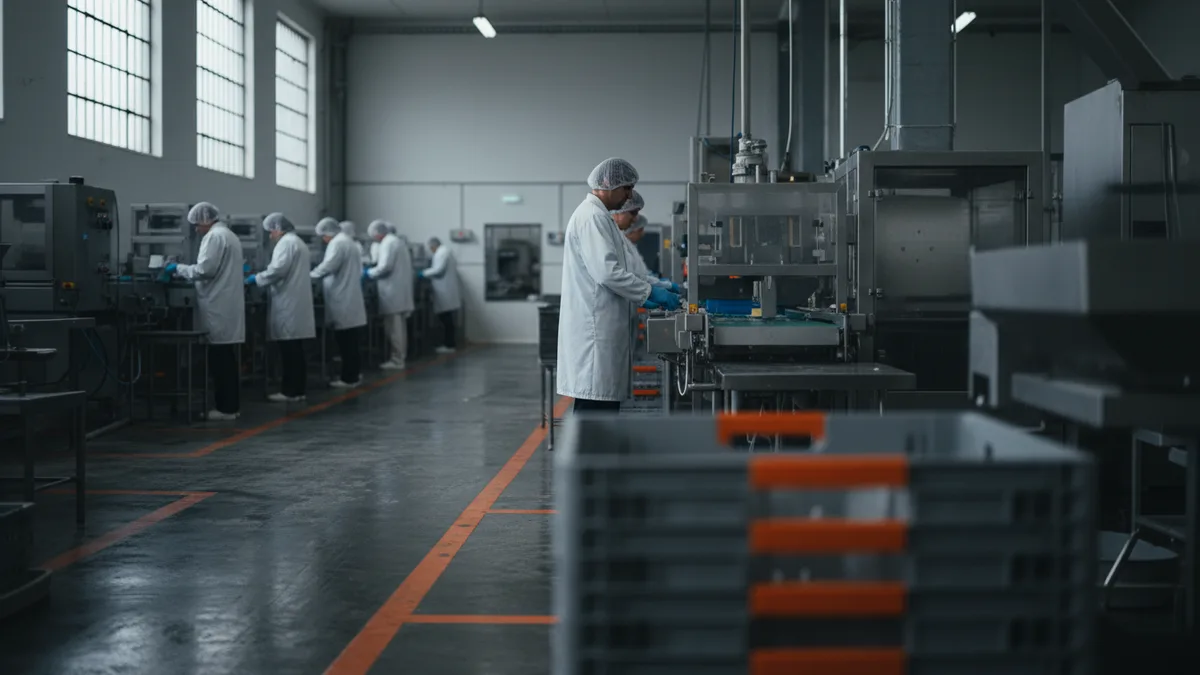
A BRC audit gets called in with 48 hours notice. Or a customer in Germany wants full traceability documentation for a batch you packed six weeks ago. Or an environmental health officer arrives at the door and asks to see your supplier approval records for the last 12 months. In every one of those situations, the product itself is probably fine. The scramble is always about the paperwork.
That scramble is not a people problem. It is a systems problem. Northern Ireland food and agri-food businesses generate enormous volumes of documentation every single week: intake records, certificates of analysis, supplier audits, temperature logs, cleaning schedules, non-conformance reports, customer specs, label sign-offs, vet checks, export health certificates. They live in different places, owned by different people, saved in different formats. When someone needs to find something quickly, the answer is almost always the same: ring the person who probably knows where it is.
Why Northern Ireland food businesses carry a heavier compliance load than most
The agri-food sector is the backbone of Northern Ireland manufacturing. It accounts for roughly a quarter of all manufacturing turnover here, and it touches almost every county: dairy processing in Tyrone and Fermanagh, red meat plants around Dungannon and Cookstown, poultry and egg production across Antrim and Down, prepared foods and ready meals closer to Belfast, and a dense network of smaller producers, packers and ingredient suppliers feeding into all of it.
That scale brings scrutiny. Retailers demand BRCGS or equivalent certification. Export customers, particularly those selling into the EU or the US, want detailed traceability at batch level. The Food Standards Agency Northern Ireland carries out its own inspection regime. And the dual-market position Northern Ireland occupies, with access to both the UK and EU markets under the Windsor Framework, means some businesses have to satisfy two sets of regulatory requirements simultaneously. The paperwork does not get lighter. It gets heavier every year.
Most businesses cope. They build systems around the people who know the systems. A quality manager who has been there fifteen years knows exactly which folder on the shared drive holds the supplier approval forms. A production supervisor knows which spreadsheet tracks the weekly CCP checks. It works, until it does not. Until that person is off sick, or leaves, or until the auditor asks for something that falls between two systems and nobody is quite sure who owns it.
What disconnected records actually cost you
The cost of poor document management in food production is rarely visible on a P and L. It shows up in other ways. Time spent searching for records before an audit, duplicated data entry across systems that do not talk to each other, customer complaints that take longer to investigate than they should because the batch history is spread across three different places. Occasionally it shows up in something more serious: a non-conformance that could have been caught earlier if the incoming inspection data had been easier to read alongside the finished product results.
There is also a quieter cost. When compliance is hard, it tends to get done to the minimum. Teams fill in the forms because they have to, not because the forms tell them anything useful. The data exists but it does not work. A temperature excursion gets logged but nobody cross-references it with the batch disposition record. A supplier gets a marginal score on their annual audit but the purchasing team never sees it because it lives in a quality folder they do not have access to. The information is there. It just does not connect.
Private AI does not fix a bad food safety culture. But it can make a good one significantly more effective, by connecting records that currently sit in isolation and making them searchable, queryable and useful to the people who need them.
Why this matters particularly for Northern Ireland
Northern Ireland agri-food businesses tend to be mid-sized by UK standards but large by local ones. A meat processing plant employing 300 people in Dungannon is a significant employer in that community. A dairy co-op in Fermanagh is central to the livelihoods of dozens of farming families. These are not businesses with a team of data scientists and a digital transformation budget. They are businesses where the quality manager is also doing the technical sign-offs, the ops director is also covering procurement gaps, and the IT function might be one person shared with finance.
That is exactly the environment where private AI can make a practical difference, not by replacing people but by giving them tools that match the scale of what they are dealing with. A system that can search across your supplier documentation, your internal audit records, your non-conformance logs and your customer specs in plain English, without needing a database query or a call to IT, is not a luxury. For a business facing a retailer audit or an export documentation request, it is genuinely useful on an ordinary Tuesday.
The privacy dimension matters here too. Supplier relationships, customer specifications, pricing structures, proprietary formulations: all of that is commercially sensitive. Putting it into a public AI tool is not something any serious food business should consider. A private AI system, running inside your own infrastructure or a dedicated private cloud, means your data stays yours. It does not feed anyone else's model. It does not end up in a response to a competitor's query.
What a private AI system can actually do in a food business
The most immediate application is document search and retrieval. Imagine being able to type a question like: show me all supplier approvals for our top ten raw material suppliers that are due for renewal in the next 90 days, or find every non-conformance record linked to a particular raw material code from the last two years. That kind of search, across documents that currently live in shared drives, email folders, quality management spreadsheets and paper files that have been scanned and forgotten, is what a well-configured private AI system can do from day one.
Beyond search, there is real value in automated reporting. Many food businesses spend significant time each week compiling the same internal reports: yield summaries, CCP check results, downtime logs, waste figures. An AI system connected to your production data can pull those reports together automatically, flag anomalies, and surface them to the right person without anyone having to export a spreadsheet and paste it into a template. That is not a futuristic capability. It is available now, built on the data you already have.
For businesses with more mature data, demand forecasting and stock management become genuinely powerful. A prepared foods producer supplying a major supermarket knows that promotional activity, seasonality and weather all affect call-off volumes, but modelling that properly takes time that nobody has. An AI system trained on your own order history, your customer forecasts and your raw material lead times can produce a working demand model that gives the buying team a better starting point than gut feel and last year's actuals.
Where to start
The businesses that get the most from AI are not the ones that try to do everything at once. They are the ones that pick one process where the pain is real and measurable, build something that works, and then extend from there.
For most food and agri-food businesses in Northern Ireland, that first process is almost always in compliance and document management. Not because it is the most glamorous application, but because the problem is universal, the data already exists, and the benefit is immediately visible. When your quality manager can find any document in 30 seconds instead of 30 minutes, that is a change she notices on the first day.
A sensible starting point is an AI Discovery: a structured audit of your existing data, systems and processes that produces a costed, ranked plan for where AI can make the biggest difference. It is not a strategy deck. It is a practical document that tells you what to build first, what it will connect to, what it will cost, and what it will save. From there, implementation is focused on one application: getting it live, getting it used, and measuring the result before moving to the next thing.
The agri-food sector in Northern Ireland is under real pressure. Input costs, labour costs, retailer margin demands, regulatory complexity: none of that is going away. The businesses that will handle it best are the ones that make their existing data work harder. That starts with being able to find it.
Is your audit paperwork keeping you up at night?
Book a free 30-minute conversation with Verona AI and find out how a private AI system built on your own data could make compliance and traceability something you stop dreading. Your records stay yours, always.
Book a free consultationMore from the Verona AI blog
The Load Is Moving but the Data Is Standing Still: What private AI can do for Northern Ireland hauliers, fleet operators and transport managers buried under driver paperwork, compliance files and margin-eating inefficiencies
Northern Ireland hauliers and fleet operators are sitting on data that could cut costs and admin. Private AI can connect it without exposing your business to public tools.
The Farmer, the Algorithm and the Field That Fought Back: A small cooperative in rural Kenya used private AI to cut crop losses by a third. Here is what that story means for the rest of us.
A Kenyan farming cooperative used AI on its own local data to cut crop losses by 34%. A Feel Good Friday story with a practical lesson for NI businesses.
Your Best Salesperson Has Never Worked a Shift: What private AI can do for Northern Ireland retailers sitting on years of customer data they never actually use
Northern Ireland retailers are sitting on years of sales, stock and customer data. Private AI can turn that into decisions. Here is where to start.