When the Line Stops, the Clock Starts: What private AI can do for Northern Ireland manufacturers who are still catching defects after the damage is done
Every defect caught late costs more than the part. For Northern Ireland manufacturers running paper-based quality checks, the real question is how much that gap is costing each week.
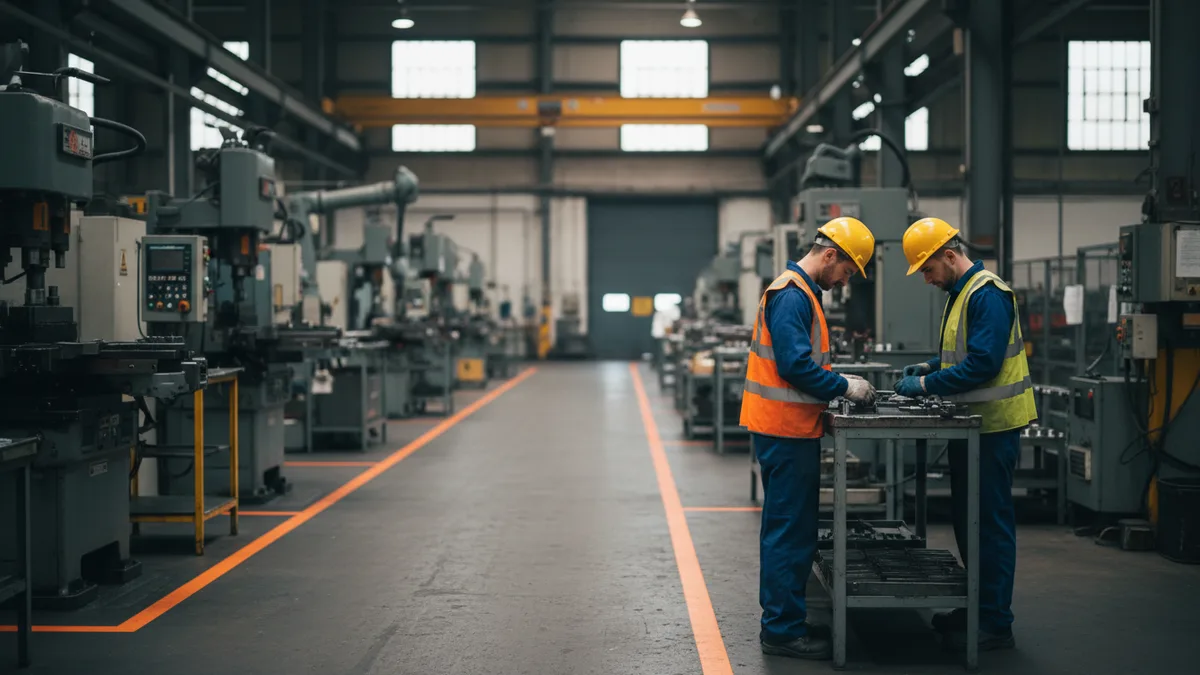
There is a particular kind of quiet dread that settles over a production manager when a customer calls before the internal team does. A batch issue that slipped past the end-of-line check, a component that was flagged on a paper sheet but never escalated, a measurement that was borderline on Tuesday and catastrophic by Thursday. In Northern Ireland manufacturing, that call happens more than anyone likes to admit.
The problem is rarely the people. Most production teams are experienced, attentive and working hard. The problem is the system around them: quality data recorded on paper or in spreadsheets, checks that happen at fixed intervals rather than continuously, and no easy way to connect what is happening on line three to what happened on line three six months ago. AI does not fix the people problem because there usually is not one. It fixes the information problem.
What quality control actually looks like in most Northern Ireland factories
Walk around a mid-sized manufacturer in Antrim, Armagh or the outskirts of Derry and you will see a version of the same picture. Operators fill in check sheets at set points in the shift. A supervisor reviews them, sometimes at the end of the day, sometimes less often. Non-conformances get logged in a folder, or in a spreadsheet on a shared drive that nobody has properly organised since 2019. If there is a quality management system, it probably captures what went wrong after the fact rather than flagging anything in real time.
This is not negligence. It is just how the process evolved, and for a long time it was good enough. The issue is that good enough has become expensive. Rework rates, customer returns, raw material waste and the labour cost of reinspection all add up in ways that are genuinely hard to see when the data is scattered across paper, spreadsheets and three different systems that do not talk to each other.
A manufacturer making precision plastic components in Lisburn, for example, might have five years of non-conformance records sitting in folders in the quality office. That data could tell you which machines drift first on a Monday morning, which raw material batches correlate with higher reject rates, and which operators catch the most borderline parts. It almost certainly does not, because nobody has had the time to look at it that way.
Why this matters specifically for Northern Ireland
Northern Ireland manufacturing sits in an unusual position. The sector is genuinely strong, with food processing, engineering, aerospace components, building products and specialist textiles all representing serious employers. But many of the businesses involved are SMEs supplying into larger UK, Irish or European supply chains, which means quality standards are set by customers with considerably more leverage than the supplier.
That pressure is not going away. Automotive and aerospace customers in particular have been tightening quality requirements steadily. Retailers and food service buyers want traceability documentation that would have seemed excessive a decade ago. And with the trading environment between Great Britain and Northern Ireland still generating its share of administrative complexity, having clean, auditable quality records is no longer just good practice. It is a commercial necessity.
The other factor is people. Experienced quality managers and production supervisors are not easy to replace. When institutional knowledge walks out the door, it takes with it the informal pattern recognition that kept defect rates manageable. AI does not replace that knowledge. But it can capture it, make it searchable and make sure it does not disappear when someone retires.
What private AI actually does in a production environment
The starting point is almost always data that already exists but is not being used properly. Machine logs, sensor outputs, ERP records, quality check sheets, supplier certificates, non-conformance reports: most manufacturers are generating more data than they realise, and very little of it connects to anything else in a useful way.
A private AI system installed inside the business, connected to those existing sources, can do several things that a paper-based or spreadsheet-based process cannot. It can monitor incoming data continuously rather than at shift intervals. It can identify patterns across time, machine, material and operator that no individual would spot by eye. It can surface a potential issue before it becomes a rejection rather than after. And it can produce the audit trail and documentation that a customer or certification body wants to see, without someone spending a Friday afternoon pulling records from three different places.
Critically, none of that data goes anywhere near a public AI tool. A manufacturer making components for a defence or aerospace customer cannot have their process parameters or supplier data sitting in a shared cloud environment. Private AI means the system runs on your infrastructure, whether that is on-site servers, a private cloud or a hybrid arrangement, and the data stays yours.
Three specific applications worth looking at first
Document and knowledge search is often underestimated as a starting point. Most quality teams spend a disproportionate amount of time finding things: the right version of a work instruction, the certificate for a specific batch of raw material, the non-conformance report from eighteen months ago that is relevant to a current issue. A private AI search tool trained on the business's own documents can cut that time dramatically, and it tends to show results quickly enough that the case for the wider system becomes obvious.
Production anomaly detection is the application that tends to get the most attention, and rightly so. By connecting to machine data or ERP outputs and learning what normal looks like for a given product and process, the system can flag deviations early. This is not about replacing the operator's judgment. It is about giving the operator better information faster, so that judgment can be applied where it matters.
Automated reporting and compliance documentation is the one that often surprises people most. The time spent preparing for audits, compiling batch records, generating customer-facing quality reports and maintaining certification documentation is significant in most factories. A system that pulls from live data and generates those documents to a consistent format does not just save time. It reduces the risk of the kind of human error that turns an audit into a difficult conversation.
Where to start if you are a Northern Ireland manufacturer
The instinct with anything labelled AI is to think it requires a large programme, a significant budget and months of disruption before anything useful happens. That is not how Verona approaches it, and it is not how it needs to work.
The right starting point is a single process where the gap between what is happening and what you know about it is costing you something measurable. For most manufacturers, that is either defect detection and rework, or the time spent producing quality documentation. Pick one, understand what data already exists around it, and build from there.
An AI Discovery engagement is a paid audit that maps the current process, identifies the data sources, and produces a costed, ranked plan for what to build first. It is not a strategy deck. It is a specific answer to a specific question: where is the first place AI will pay for itself in this factory, and what will it take to build it. From there, implementation connects the platform to existing systems and builds the first application. Managed AI then keeps it running, monitored and improving over time. The goal is something working in weeks, not a project that is still in planning when the next audit comes around.
The question worth sitting with
Most production managers already know which part of their quality process is the weakest link. They know which machine drifts, which product is most likely to generate a customer complaint, which check is most often done in a hurry. The knowledge is there. What is usually missing is a system that makes that knowledge actionable before the problem lands rather than after.
AI does not change what you know about your process. It changes what you can do with it. For a Northern Ireland manufacturer facing tighter customer requirements, a competitive market and a workforce where experience is hard to retain, that is a practical advantage worth taking seriously.
The businesses that will look back on 2026 as a turning point are not the ones that launched the biggest AI programme. They are the ones that picked one real problem, built something that worked, and then kept going.
Could your quality process be doing more?
Book a free 30-minute conversation with Verona AI and find out where a private AI system, built on your own production data, could close the gap between a defect happening and someone knowing about it.
Book a free consultationMore from the Verona AI blog
Know What You Have, Know What You Need and Stop Losing Margin to a Warehouse That Runs on Memory and Missed Orders: Practical AI tools Northern Ireland wholesalers and distributors can put to work right now
Northern Ireland wholesalers losing margin to slow order processing and stock guesswork. Private AI fixes that. Your data, your systems, no public tools.
From Farm Gate to Shelf Life, Stop Losing Margin to a Food Business That Runs on Paperwork and Tribal Knowledge: Practical AI tools Northern Ireland food producers, processors and agri-food managers can put to work right now
Northern Ireland food and agri-food businesses are losing margin to manual paperwork and disconnected data. Here is how private AI changes that.
Build Smarter, Quote Faster and Stop Losing Margin to a Construction Business That Runs on Spreadsheets and Sticky Notes: Practical AI tools Northern Ireland builders, contractors and property managers can put to work right now
Northern Ireland contractors are losing margin to slow quoting, missed variations and paper-heavy admin. Private AI can change that without exposing your data.