The Stock Was on the System but Not on the Shelf: What private AI can do for Northern Ireland cold storage and chilled distribution businesses buried under inventory records, supplier lead times and demand patterns that never quite add up
Every chilled warehouse in Northern Ireland has a version of the same problem. The system says there are fourteen pallets. The forklift driver knows there are nine. Somewhere between those two numbers, margin disappears.
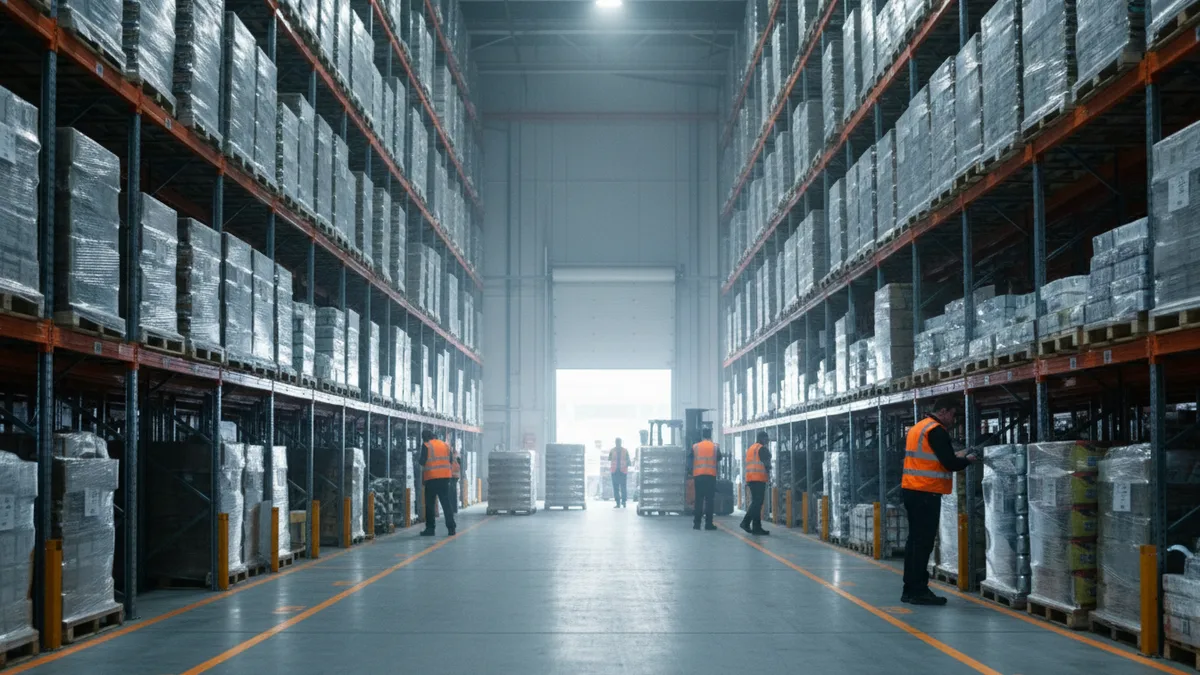
There is a spreadsheet in most chilled distribution businesses in Northern Ireland that everyone uses and nobody fully trusts. It started as a sensible workaround when the main system could not quite capture what was happening on the floor. Someone added a tab for returns. Then a tab for the supplier that always delivers short. Then a column for the product lines that move differently in the weeks before Christmas and the weeks after Easter. By now it has seventeen tabs, two people who understand it, and a standing item on the weekly operations meeting agenda that usually ends with someone saying they will look into it.
The frustrating thing is that the data to fix this almost certainly exists already. It is sitting in the WMS, the accounts package, the ERP if there is one, the purchase order history, the customer order files and the delivery manifests. The problem is not a shortage of data. The problem is that none of those systems talk to each other in a way that produces a reliable, current picture of what is actually in the building, what is coming in, what has been promised out and what the next ten days are likely to look like. That is the gap that a private AI system, connected to the systems a business already runs, is well placed to close.
Why chilled and cold storage is a harder problem than ambient
Ambient wholesale has its own stock headaches, but chilled and cold storage adds a layer that makes errors genuinely expensive. Short shelf life means that a forecasting mistake does not just sit on a shelf for a few extra weeks. It becomes a write-off. An unexpected uplift from a major retail account on a Thursday afternoon can clear out a product line that was earmarked for a foodservice customer collecting on Friday morning. A supplier short-delivery that does not get flagged until the pick starts means the order goes out wrong, or goes out late, or does not go out at all.
The margin in chilled distribution is not generous at the best of times. Most businesses running ambient product can absorb a few percentage points of stock inaccuracy without it showing up sharply on the P and L. In chilled, the same inaccuracy tends to show up as waste, as a service failure, or as an emergency buy-in at a price that wipes out the week. The operational tolerance is much tighter, which is why getting a more accurate, more connected view of stock and demand matters more here than almost anywhere else in the supply chain.
The systems are not broken, they just do not connect
Most chilled distributors operating out of Belfast, Derry, Newry or the wider agri-food corridor running through Tyrone and Armagh are not running bad systems. They have a WMS that does what a WMS does. They have Sage or Xero or an industry-specific accounts package. They have a transport management system, or at least a spreadsheet that functions as one. They have customer order histories going back years. Some have an ERP that was implemented a decade ago and covers about sixty percent of what the business actually does now.
The issue is integration, or rather the absence of it. Each system holds a piece of the picture. Nobody has built the connection that would let a warehouse manager open a single view and see: current confirmed stock by product and location, inbound deliveries expected in the next forty-eight hours with a confidence rating based on that supplier's actual delivery history, outbound commitments for the same window, and a flagged list of the lines where supply and demand do not match. That view is not technically difficult to build. It requires connecting the data sources, applying some logic, and surfacing the result in something a warehouse manager will actually use. That is precisely the kind of application a private AI platform can run.
Why this matters specifically for Northern Ireland
Northern Ireland's food and chilled distribution sector sits in an unusual position. It serves retail, foodservice and export customers with different service expectations and different order patterns. It operates across a relatively small geography but with real infrastructure constraints, particularly around the ports at Belfast and Warrenpoint and the road links that determine how reliably suppliers can hit a morning delivery slot.
The businesses that supply into the major retail multiples operating here are working to tight service level agreements. A missed delivery or a short pick does not just cost the immediate order. It triggers a deduction, a service failure report, and sometimes a conversation about ranging. For smaller businesses supplying into the hospitality trade in Fermanagh or the Causeway Coast, the risk is different but equally real. A chef who orders thirty portions of a protein and receives twenty does not quietly accept a credit note. They phone someone else next time. The cost of a stock error in this sector is rarely limited to the value of the product involved.
There is also a specific Northern Ireland dimension around the volume of small and medium suppliers crossing from the Republic, many of whom operate on informal lead time agreements that are not captured in any system. When a regular supplier rings to say the load will be a day late, that information sits in someone's head or in a WhatsApp message, not in the WMS. A connected AI system that can take that update, match it against committed outbound orders and flag the resulting gaps before the pick starts is not a luxury. For a business running tight, it is the difference between managing a problem and discovering it too late.
What a private AI system actually does here
The starting point is not a large transformation programme. It is one process where the gap between what the system says and what is actually happening is costing money or time in a measurable way. For most chilled distributors, that process is stock accuracy and short-term demand visibility.
A private AI platform installed inside the business, connected to the WMS, the order management system and the accounts package, can build a consolidated stock and demand view that updates continuously rather than at the end of the day. It can apply the business's own historical order data to produce a short-range demand forecast by product line, weighted by the seasonal patterns and customer-specific behaviours that the business already knows about but has never been able to encode in a system. It can flag the lines where the forecast and the current stock position suggest a problem is coming, before the pick starts and before the customer rings.
Critically, none of this requires the commercial data to leave the building. Customer order histories, supplier performance records, pricing, margins, account terms: all of it stays on the business's own infrastructure. It does not go into a public AI tool. It is not used to train a model that will be shared with anyone else. The system is built on the business's own data, tuned to the way that business actually operates, and it runs inside an environment the business controls.
Where to start
The most useful first step is not a technology decision. It is an honest audit of where the biggest gap currently sits. For most chilled distribution businesses, that audit will point to one of three places: the accuracy of the stock position at any given moment, the reliability of the short-range demand forecast, or the speed at which supplier delivery information gets into the system and matched against outbound commitments.
Verona AI's starting point with any business is an AI Discovery engagement. That is a paid audit that looks at the data the business already holds, the systems it already runs, and the processes where the cost of inaccuracy is highest. It produces a costed, ranked plan showing which application to build first and what a realistic return looks like. It is not a strategy presentation. It is an engineering-level assessment of what is actually possible with the data and systems already in place.
The businesses that get the most from this are not the ones with the most sophisticated technology. They are the ones that pick one process, measure the cost of the current problem clearly, and build something that fixes it. A chilled distributor that reduces stock write-off by even a small percentage, or cuts the number of short picks per week by half, will see a return that is visible on the P and L within a quarter. That is the kind of result that justifies the next application, and the one after that.
The spreadsheet is not the problem, it is the symptom
The seventeen-tab spreadsheet that everyone uses and nobody trusts did not appear because the people running the business were disorganised. It appeared because the systems they had did not give them the view they needed, so they built one themselves using the tools available. That is a rational response to a real problem.
What has changed is that it is now possible to build a proper connected system on top of the data and infrastructure a business already has, without a multi-year ERP implementation and without putting commercial data into a public platform. The spreadsheet can be retired. The standing agenda item can come off the weekly meeting. The forklift driver and the system can agree on how many pallets are actually in the building. That is a modest ambition, but for a business running on tight margins in a sector where a short pick or a write-off week can define the month, it is worth taking seriously.
Is your stock data working against you?
If the gap between your system and your shelf is costing you time and margin, it is worth a conversation. Book a free thirty-minute call with Verona AI and we can talk through what a private AI system, built on your own data, could actually do for your operation.
Book a free consultationMore from the Verona AI blog

The Customer Rang on a Tuesday and the Answer Was in a Filing Cabinet from 2019: What private AI can do for Northern Ireland agri-merchants and rural suppliers buried under product records, account histories and compliance paperwork that nobody can find at the right moment
Northern Ireland agri-merchants are drowning in paper. Private AI connects your stock, accounts and compliance records so answers are seconds away, not hours.
The Variation Was Agreed but Never Recorded: What private AI can do for Northern Ireland contractors buried under drawings, contracts and site decisions that exist only in someone's memory
Northern Ireland contractors lose time and money when site decisions go unrecorded. Private AI can connect your documents, drawings and contracts in one place.

The File Was There but Nobody Could Find It in Time: What private AI can do for Northern Ireland professional services firms buried under client documents, compliance records and institutional knowledge that only one person knows how to find
Northern Ireland professional services firms lose hours every week hunting documents. Private AI fixes that without sending client data to public tools. Here is how.