The Variation Was Agreed but Never Recorded: What private AI can do for Northern Ireland contractors buried under drawings, contracts and site decisions that exist only in someone's memory
On most construction sites, the real project lives in email threads, WhatsApp messages and the heads of people who might leave next month. Private AI can change that, without sending a single document outside your business.
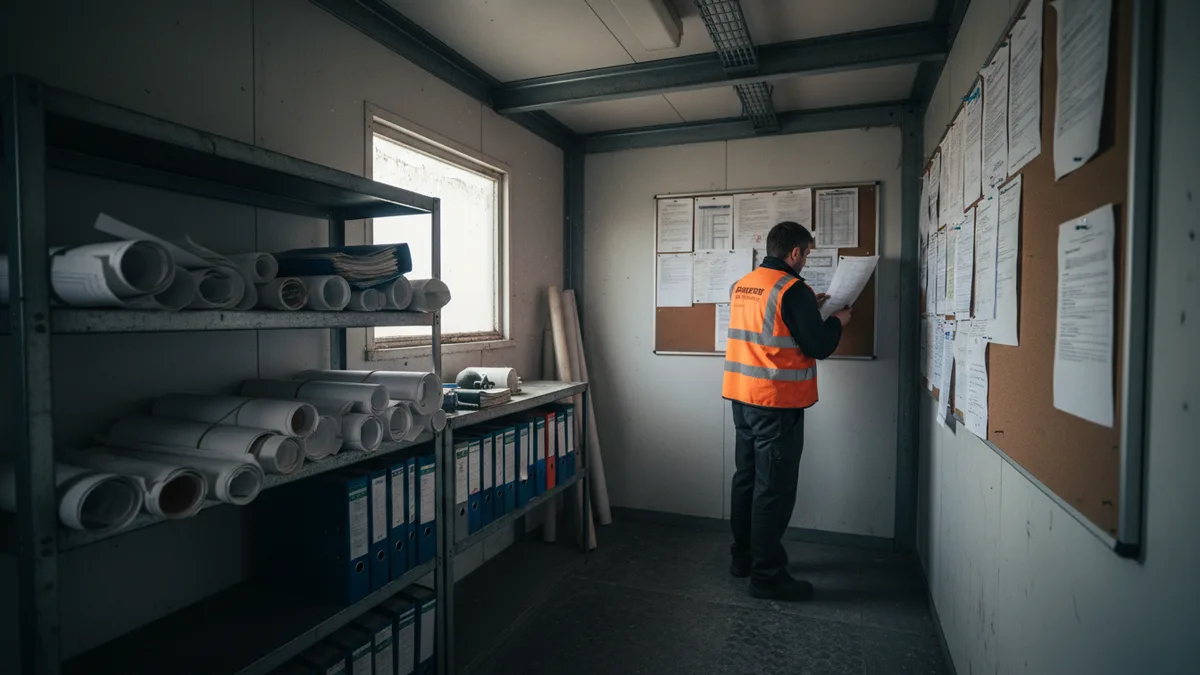
There is a particular kind of argument that happens on construction sites across Northern Ireland every few weeks. Two people who were both present at the same meeting remember it differently. One says the blockwork spec was changed to hit a programme date. The other says it was only ever discussed, never confirmed. The email that would settle it is somewhere in a chain of forty-seven replies, or it was sent from a personal phone, or the site manager who handled it left in the spring. The variation gets disputed. The invoice gets queried. The relationship gets strained. And somewhere in the background, a subcontractor is waiting to be paid.
This is not a story about bad people or badly run businesses. It is a story about the way construction work actually moves, fast, verbally, across multiple sites, multiple trades and multiple document versions, with decisions made under time pressure and recorded inconsistently if they are recorded at all. The paperwork infrastructure never quite keeps up with the physical one. Private AI does not fix human nature, but it can close the gap between what was decided and what was written down, and it can make sure that when something was written down, you can actually find it.
The document problem is bigger than most contractors realise
A medium-sized contractor in Northern Ireland, say a firm turning over four to eight million a year with two or three live sites at any time, will generate a remarkable volume of documents. Drawings in multiple revisions. Specifications from architects and engineers. Subcontract orders and variations. RFIs and their responses. Inspection records, health and safety files, RAMS, waste transfer notes, material delivery dockets. Programme updates. Correspondence with the client, the QS, the main contractor if you are working as a sub, the council building control office, and the utility companies.
Most of that material sits in different places. Some is in a project folder on a shared drive that was set up with good intentions but drifted into inconsistency by week three. Some is in email. Some is in WhatsApp threads that nobody backed up. Some is in a lever arch file in the site cabin that will get thrown in a van at practical completion and never looked at again unless something goes wrong. The problem is not that the documents do not exist. The problem is that nobody can find the right one quickly enough when it matters, and nobody can be confident they are looking at the current version.
Why Northern Ireland specifically
Construction in Northern Ireland has some characteristics that make this worse than it might be elsewhere. The sector is dominated by small and medium-sized firms. Many of them work across a wide geography, from Belfast city centre projects to rural County Fermanagh sites, with tight teams that cannot afford a dedicated document controller on every job. The public sector procurement environment, with its particular requirements around compliance, audit trails and record-keeping, adds another layer of administrative pressure on top of already stretched back offices.
There is also the question of supply chains. Northern Ireland contractors often work with subcontractors and suppliers on both sides of the border, which means contracts, specifications and correspondence can arrive in different formats, under different legal frameworks, and with different expectations about how variations and instructions should be recorded. The firms that manage this well tend to have one or two people who carry the knowledge in their heads. When those people leave, or go off sick, or simply cannot be reached on a Friday afternoon, the business discovers how thin the systems underneath them actually are.
What private AI can actually do here
The starting point for most construction firms that work with Verona is not a grand transformation programme. It is usually one specific, painful problem. The most common one is contract and variation search: the ability to ask a question of your own documents and get a reliable answer. Which revision of that drawing was issued before the pour date? What did the subcontract order actually say about dayworks rates? Was there a written instruction covering the additional groundworks, or only a verbal agreement followed by an email that nobody filed properly?
A private AI platform installed inside your business, connected to your shared drive, your email archive and your project folders, can index all of that material and let you search it the way you would search the internet. Not with a file name, but with a question in plain English. The results come with source references so you can go straight to the document, not just a summary of it. Critically, none of that material ever leaves your systems. It does not go into a public AI tool. It does not train anyone else's model. Your contract data, your client relationships, your pricing, your correspondence with solicitors about a disputed final account, all of it stays inside your own infrastructure.
Beyond search, the same platform can support other processes. Automated variation logs that pull from email and document activity. Compliance checklists that check themselves against the documents you have actually produced, rather than the ones you intended to produce. Reporting that draws from live project data rather than a spreadsheet someone updates when they remember. These are not theoretical capabilities. They are built on the documents and systems a contractor already has.
The variation log problem is a good place to start
If you want to identify the single process where private AI is most likely to pay for itself quickly in a construction business, it is variation management. Disputed variations are one of the most consistent sources of cash flow pain in the sector. A variation that was agreed verbally and never confirmed in writing is a variation that might not get paid. A variation that was instructed in writing but never added to the running log is a variation that gets forgotten at final account stage. A variation that was priced and submitted but never chased is money sitting in a file.
An AI application built on your own project data can maintain a live variation log by reading your correspondence and flagging anything that looks like an instruction, a change or a request for additional work. It does not replace the judgement of your QS or contracts manager. It makes sure they are not starting from scratch every time they sit down to prepare a valuation. The time saving is real. More importantly, the reduction in things falling through the cracks is real, and in construction, things that fall through the cracks tend to cost money.
Where to start if you are a Northern Ireland contractor
The right starting point is an AI Discovery: a structured audit of your current document flows, your systems, and your biggest administrative pain points. That process produces a costed, ranked plan that tells you which application to build first and what it will actually take to build it. It is a paid piece of work, not a free strategy deck, because the output needs to be specific enough to act on.
For most construction firms, the first application is either document and contract search or variation and instruction tracking. Both can be built on the data you already have. Neither requires you to change your project management software or your accounting system, because the AI connects to what you already use rather than replacing it. Implementation typically takes weeks, not months, and the first application is live and measurable before you commit to anything further.
The firms that get the most from this are the ones that pick one problem, build something that solves it properly, and then expand from there. Not a big transformation. Not a new system that needs a year of training. One process that works better, with the evidence to show it, and a platform underneath that can keep building on top of it.
Could your contracts and site records work harder for you?
If variations, drawings and compliance documents are slipping through the cracks, a free 30-minute conversation with Verona AI costs nothing. We build private AI on your own data, so nothing leaves your business.
Book a free consultationMore from the Verona AI blog
The File Was There but Nobody Could Find It in Time: What private AI can do for Northern Ireland professional services firms buried under client documents, compliance records and institutional knowledge that only one person knows how to find
Northern Ireland professional services firms lose hours every week hunting documents. Private AI fixes that without sending client data to public tools. Here is how.
The Coral Reef That Learned to Talk Back: A team of marine scientists gave AI a voice underwater, and what they built is changing how we protect the ocean
A Feel Good Friday story about AI helping marine scientists restore coral reefs, and what that spirit of practical innovation means for NI businesses.
The Machine Stopped and Nobody Wrote It Down: What private AI can do for Northern Ireland manufacturers buried under maintenance logs, production records and engineering knowledge that walks out the door when people retire
Northern Ireland manufacturers lose hours chasing maintenance history and engineering know-how. Private AI keeps that knowledge inside the business. Here is how.