The Farmer, the Algorithm and the Field That Fought Back: A small cooperative in rural Kenya used private AI to cut crop losses by a third. Here is what that story means for the rest of us.
Sometimes the most important AI story of the week happens in a red-soil field outside Nakuru, not in a Silicon Valley press release. This one is worth five minutes of your Friday.
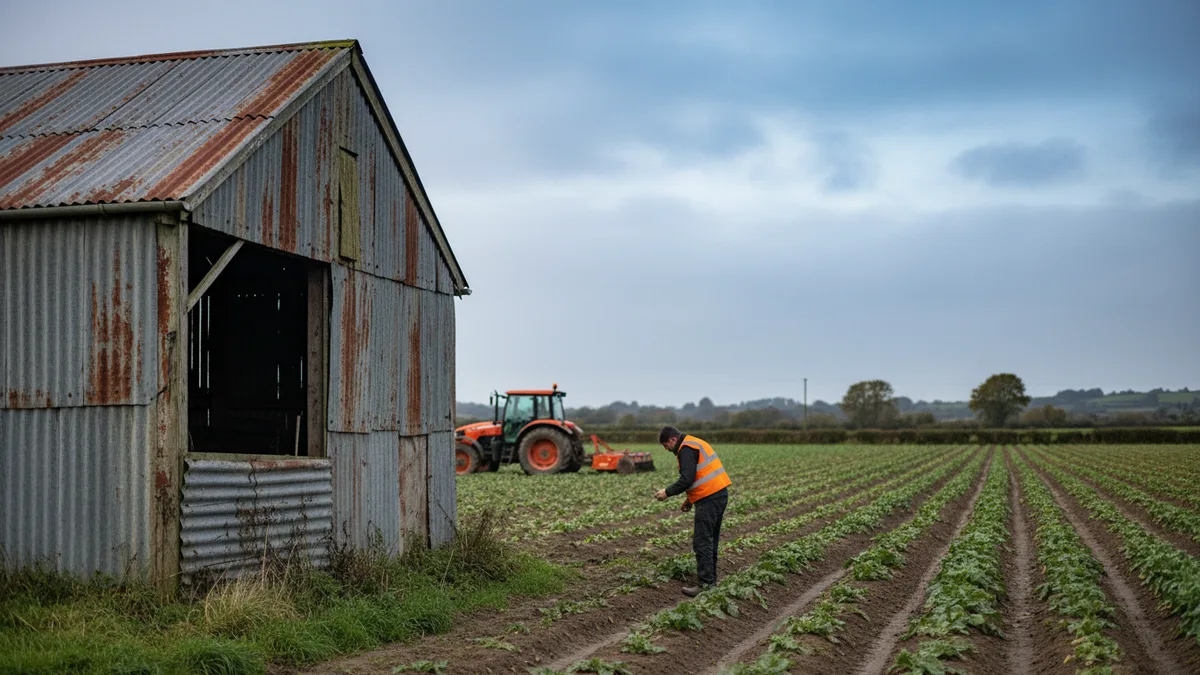
There is a cooperative of about 340 smallholder farmers working land outside Nakuru, in Kenya's Rift Valley. They grow maize, beans and a rotating mix of vegetables, and for most of the past decade they lost somewhere between a quarter and a third of each harvest to a combination of late blight, unpredictable rainfall and the kind of pest pressure that arrives without much warning and leaves fast. The losses were not dramatic. No single catastrophic event. Just a steady, grinding erosion of margin that kept families in a cycle they could not quite break out of.
In 2024, a small NGO partnered with a Nairobi-based technology team to install a local AI system on a server in the cooperative's shared storage facility. Not a cloud subscription. Not a tool that sent data to a server farm somewhere else. A private system, running on the cooperative's own records, fed by cheap soil sensors, a local weather station and three years of handwritten harvest logs that a volunteer spent six weeks digitising. By the end of the first full growing season the cooperative had cut its post-harvest losses by 34 percent. That number came from their own records, compared against their own baseline. No consultancy dressed it up. It just happened, quietly, in a corrugated iron building with a decent internet connection and a system that finally knew the difference between this field and the one two kilometres away.
What they actually built and why it worked
The system was not complicated in concept, even if the engineering took patience. It combined the digitised harvest logs with daily sensor readings and matched patterns across seasons. When soil moisture in a particular plot dropped below a threshold that historically preceded a pest outbreak in that same plot, the system flagged it. A simple alert, sent by SMS to the field coordinator for that zone. Not a prediction for the whole region. A specific, localised nudge based on that land's own history.
That specificity is the thing. Generic agricultural AI tools exist and some of them are genuinely useful. But they are trained on broad datasets that average out the quirks of any individual place. This system learned from this cooperative's records, this soil, this microclimate. The farmers recognised the outputs because the outputs reflected their own experience back at them in a more organised form. That trust mattered as much as the technology.
The team also built a simple document search tool on top of the same platform, letting field coordinators pull up supplier agreements, grant conditions and compliance records without having to phone the central office. A small thing. But it saved hours every week that previously disappeared into filing cabinets and unanswered calls.
Why this story travels
It would be easy to read this as a development story, something that applies to resource-constrained settings but not to a well-run business in County Antrim or County Down. That reading would be wrong.
The conditions that made this project work are not unique to rural Kenya. A body of historical records that nobody has ever properly analysed. Disconnected sources of information that individually tell you very little but together tell you quite a lot. A team that is too busy running the operation to step back and look at the patterns. A margin problem that is not caused by one big failure but by dozens of small, recurring ones.
Those conditions describe a significant number of food producers, processors and agri-food businesses operating in Northern Ireland right now. The harvest logs in Nakuru are not so different, structurally, from the batch records and yield sheets sitting in a folder on a shared drive in Dungannon or Ballymena. The challenge is the same: getting the information to talk to itself before the problem becomes expensive.
Why this matters specifically for Northern Ireland
Northern Ireland's food and agri-food sector is not short of data. Farms are increasingly instrumented. Processing facilities generate batch records, quality checks, temperature logs and supplier documentation at a rate that would have been unimaginable twenty years ago. The problem is almost never a shortage of information. It is that the information lives in separate places and nobody has the time to connect it.
There is also a particular pressure here that does not apply everywhere. Northern Ireland food businesses operate across two regulatory environments, supply into GB and Irish markets simultaneously, and face compliance requirements that layer on top of each other in ways that create real administrative weight. A business that can search its own compliance records instantly, flag a supplier document that is about to expire, or spot a yield pattern that precedes a quality failure has a genuine operational edge. Not a theoretical one. A measurable one.
The cooperative in Nakuru did not wait for the perfect system. They started with what they had: three years of handwritten logs and a willingness to digitise them. Most Northern Ireland food businesses are already well past that starting point. The data exists. The question is whether it is working for you or just sitting there.
The private part matters more than people realise
One detail in the Nakuru story that did not make the headline is worth dwelling on. The cooperative specifically chose not to use a cloud-based agricultural platform, even though several were available and some were free at the point of use. The reason was straightforward: their harvest data, their soil profiles and their supplier relationships were commercially sensitive within their own regional market. Sharing that data with a platform that might aggregate it, sell insights from it or simply expose it to a data breach was not a risk they were willing to take for the sake of convenience.
That reasoning is exactly the same reasoning that applies to a food manufacturer in Cookstown or a wholesale distributor in Newry. The data that makes an AI system genuinely useful, your customer order history, your yield records, your pricing, your supplier terms, is also the data you least want sitting in a public system. A private AI installation, running on your own infrastructure or in a dedicated private cloud, means the insight stays yours. Nobody else's model gets smarter because of your information.
This is not a niche concern for large enterprises with legal teams. It is a basic commercial consideration for any business where the data is the competitive advantage.
Where to start if this resonates
The cooperative did not begin with a grand transformation programme. They began with one question: why do we keep losing yield in the same plots at the same time of year, and do our records actually show a pattern? That question led to the digitisation project, which led to the system, which led to the 34 percent reduction.
For a Northern Ireland food or agri-food business, the equivalent first question might be: where are we losing margin in a way that feels predictable but that we have never actually measured? It might be in yield variation across production runs. It might be in supplier quality that drifts before it fails. It might be in the time spent pulling together compliance documentation for an audit that happens every six months like clockwork.
Pick one of those. Find out where the relevant data lives. That is usually enough of a starting point to understand whether a focused AI application could help. It does not require a full audit of your entire operation. It requires one honest look at one recurring problem and the data trail it leaves behind.
A small thing, done well, in the right place
The Nakuru story is a good one to end a week on because it is not about scale or spectacle. Nobody raised a hundred million dollars. No famous technology company issued a press release. A small team built something specific for a specific group of people using the records those people already had, and it worked well enough to make a material difference to several hundred families.
That is the version of AI that tends to get overlooked in the coverage, which gravitates toward the dramatic and the enormous. But it is also the version that is most likely to be relevant to a business owner sitting in an office in Lisburn or Omagh on a Friday afternoon wondering whether any of this actually applies to them.
It does. The scale is different. The crops are different. The regulatory context is completely different. But the core situation, data that exists, patterns that repeat, a margin problem that compounds quietly, and a team too stretched to see it clearly, is recognisable. That is where private AI, built on your own systems and your own records, tends to earn its keep.
Could your business do something similar?
If this story sparked an idea about your own data, Verona AI offers a free 30-minute conversation to talk through what private AI built on your own systems could look like in practice. No pitch, no pressure, just a straight conversation.
Book a free consultationMore from the Verona AI blog
Your Best Salesperson Has Never Worked a Shift: What private AI can do for Northern Ireland retailers sitting on years of customer data they never actually use
Northern Ireland retailers are sitting on years of sales, stock and customer data. Private AI can turn that into decisions. Here is where to start.

The Notes Are There But Nobody Can Find Them: What private AI can do for Northern Ireland care providers, GP practices and health sector organisations buried under records, rotas and regulatory paperwork
Northern Ireland care providers are drowning in records and admin. Private AI can search, summarise and automate without exposing patient data. Here is how.

The Advice Is in There Somewhere: What private AI can do for Northern Ireland legal firms, accountants and professional services businesses buried under documents they cannot search
Northern Ireland law firms and accountants hold years of valuable data they can rarely search. Private AI changes that without exposing client files to public tools.