The Load Is Moving but the Data Is Standing Still: What private AI can do for Northern Ireland hauliers, fleet operators and transport managers buried under driver paperwork, compliance files and margin-eating inefficiencies
Every truck on the road generates data. Most of it dies in a folder nobody opens. Here is what changes when you actually use it.
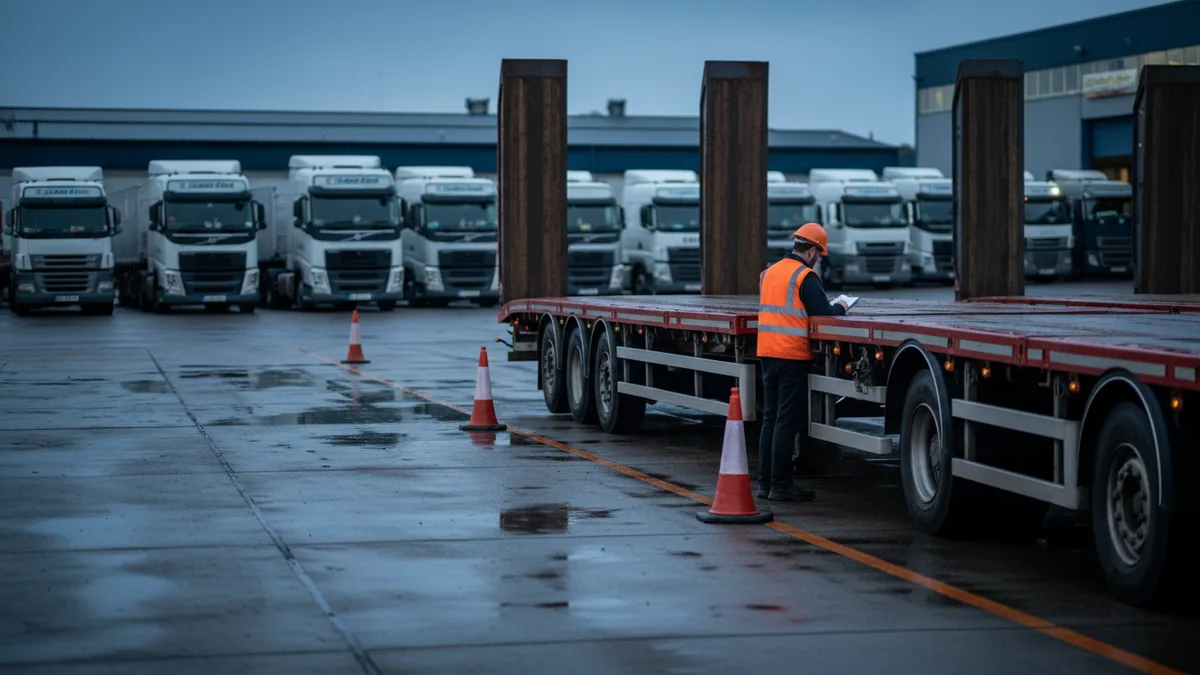
There is a haulage firm somewhere between Newry and Belfast right now whose drivers are filling in paper tachograph envelopes, whose transport manager is cross-referencing three different spreadsheets to build a weekly debrief, and whose accounts team is manually keying delivery confirmations into a system that does not talk to the TMS. Nobody chose this. It just accumulated, job by job, over fifteen years. The margin pressure is real, the compliance clock never stops, and the people who could fix it are too busy keeping the wheels turning to step back and look at the whole picture.
That is the situation for a significant chunk of Northern Ireland logistics and transport. Not the big mainland operators with dedicated IT departments and software budgets the size of a small country, but the owner-managed hauliers, the regional distribution firms, the cold-chain specialists running out of Portadown or Antrim or Londonderry. They have data. Quite a lot of it, actually. It is just scattered across systems that do not speak to each other, inside documents nobody has time to read, and in the heads of drivers and planners who have been doing this for twenty years. Private AI does not fix all of that overnight, but it can make a measurable dent, starting with the processes that bleed the most time and money.
Why Northern Ireland transport businesses are under particular pressure right now
The post-Brexit trading environment added a layer of paperwork to cross-border and GB-facing movements that simply did not exist before 2021. Customs declarations, commodity codes, rules-of-origin checks: these are not complicated in isolation, but when you are processing dozens of consignments a day and relying on a small admin team, the cumulative load is punishing. One missed field on a movement document can hold a trailer at a port for hours. Hours that show up as dead cost on a job that was already tight.
Northern Ireland also has a transport sector that skews heavily towards smaller operators. The majority of haulage firms here run fewer than fifty vehicles. That means no dedicated compliance officer, no data analyst, no IT team. The transport manager is often also the driver scheduler, the customer contact and the person who fields the phone call at half past six when a trailer breaks down outside Dungannon. Asking that person to also extract insight from operational data is not realistic without tools that do the heavy lifting for them.
Fuel, driver wages and vehicle maintenance have all risen sharply over the past three years. The firms that are holding margin are mostly doing it by sweating their existing assets harder, reducing empty running, improving load utilisation and tightening up on the admin costs that quietly inflate every job. AI applied to real operational data can help with all three of those things, but only if the data is actually connected and usable.
What the data looks like inside a typical transport business
Most transport and logistics firms have more data than they realise. There is the TMS or planning system, often something like Mandata or a bespoke Access database built years ago. There is the vehicle telematics feed, which records location, speed, idling time and fuel consumption but which most planners glance at rather than analyse. There is the maintenance system, or more often a spreadsheet and a folder of invoices. There are driver hours records, either from digital tachographs or paper. There are POD documents, delivery notes, customer rate cards, subcontractor invoices and email threads going back years.
None of these talk to each other. A planner building a route knows roughly what each driver costs per hour and roughly what the fuel burn should be, but producing an accurate job-level margin figure means pulling from four different places and doing arithmetic that is one typo away from being wrong. A compliance audit means someone physically going through files. A customer query about a delivery from three months ago means a search through email and a phone call to the driver.
Private AI, installed inside your own infrastructure and connected to the systems you already have, can change what is possible with that data. Not by replacing your planning system or your TMS, but by sitting alongside them and making the information inside them accessible and useful in ways that are not currently practical.
Why this matters for Northern Ireland specifically
Northern Ireland transport businesses operate across a genuinely complex geography. You have the island of Ireland dynamics, the GB land bridge, ferry routes from Belfast and Larne, and the particular compliance requirements that come with the Windsor Framework. A firm moving refrigerated goods from a Fermanagh food producer to a retailer in Manchester is navigating more documentary complexity than an equivalent English haulier doing the same distance.
That complexity creates administrative cost. It also creates risk. A compliance failure on a cross-border movement is not just a fine. It is a delayed trailer, an angry customer and a conversation with a driver who is already on hour nine of a long day. AI that can check a movement document against the required fields before it leaves the yard, flag a missing commodity code or cross-reference a subcontractor certificate of insurance that expired last week, is not a luxury. It is a practical risk management tool.
There is also a talent dimension to this. Finding experienced transport managers and compliance staff in Northern Ireland is genuinely difficult. The pool is not large and the good ones are busy. AI that automates the routine parts of compliance checking, report generation and document processing does not replace those people. It makes them more effective, and it means that when someone leaves, you are not entirely dependent on what was in their head.
Four processes where private AI makes a practical difference
The first is document processing and compliance checking. Delivery notes, CMRs, customs entries, driver licence checks, vehicle inspection reports: these are high-volume, repetitive documents where errors are costly. An AI system trained on your own document formats can read, extract and cross-reference these automatically, flagging exceptions rather than requiring a human to check every line.
The second is job costing and margin reporting. If your TMS holds rates and your telematics holds actual fuel data and your accounts system holds driver costs, an AI layer connecting those three can produce accurate job-level margin figures without anyone having to build a spreadsheet. That means you know, within hours of a job completing, whether it made money, and you can see patterns across customers, routes and vehicle types that are invisible when the data lives in separate places.
The third is maintenance and vehicle availability. Predictive maintenance is talked about a lot in transport circles, usually in the context of enormous fleets. But even a firm running twenty vehicles benefits from an AI system that reads telematics data and service history together and flags which vehicles are showing patterns that historically precede a breakdown. One avoided roadside failure on a timed delivery pays for a significant amount of software.
The fourth is knowledge and document search. Every transport business has years of rate cards, subcontractor agreements, customer contracts and internal procedures sitting in shared drives or email folders. When a query comes in or a dispute arises, finding the relevant document takes time nobody has. A private AI search tool trained on your own document library can surface the right file in seconds, without that information ever leaving your systems or going anywhere near a public AI tool.
Where to start and what to avoid
The temptation with any new technology is to try to fix everything at once. That is almost always the wrong approach, and in transport it is particularly dangerous because the operational consequences of a system problem are immediate and visible. A trailer sitting in the wrong place or a driver with the wrong paperwork is not an abstract IT failure. It is a real problem with a real customer on the phone.
The better approach is to pick one process that is genuinely painful, where the cost of the current situation is clear and the data to improve it already exists. For most Northern Ireland transport businesses, that is either compliance document checking or job-level margin reporting. Both are high-frequency, both rely on data you already have, and both produce a measurable result within weeks rather than months.
What Verona does is start with an AI Discovery audit: a structured look at your systems, your data and your processes that produces a ranked list of where AI will actually move the needle, with realistic costs and timelines attached. That means you are not committing to a large programme on the basis of a vendor promise. You are making a decision based on your own operational data, with a clear view of what the first application will cost and what it should deliver.
One thing worth saying plainly: the data inside your transport business, your rates, your customer relationships, your operational patterns, is commercially sensitive. Putting it into a public AI tool is not the answer. Private AI, running inside your own infrastructure, means that data stays yours. It does not train anyone else models. It does not end up informing a competitor analysis somewhere. That is not a minor technical detail. For a business where margin is tight and relationships are hard-won, it matters.
The practical case for moving now rather than later
There is a version of this conversation that says the technology is still maturing, wait another year. That is a reasonable position for someone with comfortable margins and no pressing operational pain. It is less reasonable if your admin team is drowning in compliance paperwork, your job costing is done on instinct, and your best transport manager is the only person who knows where anything is.
The firms that will be in the strongest position in three years are the ones that started connecting their data and automating their routine processes now, not because they were early adopters chasing technology, but because they made a practical decision to stop losing time and margin to problems that are genuinely solvable. Northern Ireland has real strengths in transport and logistics: geographic position, a skilled workforce, deep relationships with food and manufacturing clients. Private AI is one of the tools that helps a well-run firm here compete against larger operators with bigger overhead structures. It is not magic. But applied to the right process, it works.
Could your fleet data be working harder for you?
Book a free 30-minute conversation with Verona AI to talk through where private AI, built on your own operational data, could make the biggest difference to your transport or logistics business.
Book a free consultationMore from the Verona AI blog

The Farmer, the Algorithm and the Field That Fought Back: A small cooperative in rural Kenya used private AI to cut crop losses by a third. Here is what that story means for the rest of us.
A Kenyan farming cooperative used AI on its own local data to cut crop losses by 34%. A Feel Good Friday story with a practical lesson for NI businesses.
Your Best Salesperson Has Never Worked a Shift: What private AI can do for Northern Ireland retailers sitting on years of customer data they never actually use
Northern Ireland retailers are sitting on years of sales, stock and customer data. Private AI can turn that into decisions. Here is where to start.

The Notes Are There But Nobody Can Find Them: What private AI can do for Northern Ireland care providers, GP practices and health sector organisations buried under records, rotas and regulatory paperwork
Northern Ireland care providers are drowning in records and admin. Private AI can search, summarise and automate without exposing patient data. Here is how.