Less Paperwork, More Care and Stop Losing Time to a Practice That Runs on Folders and Phone Calls: Practical AI tools Northern Ireland GP practices, care providers and health sector managers can put to work right now
Every hour a care coordinator spends chasing paperwork is an hour they are not spending with a patient or resident. Private AI built on your own data and systems can change that ratio without sending a single confidential record outside your organisation.
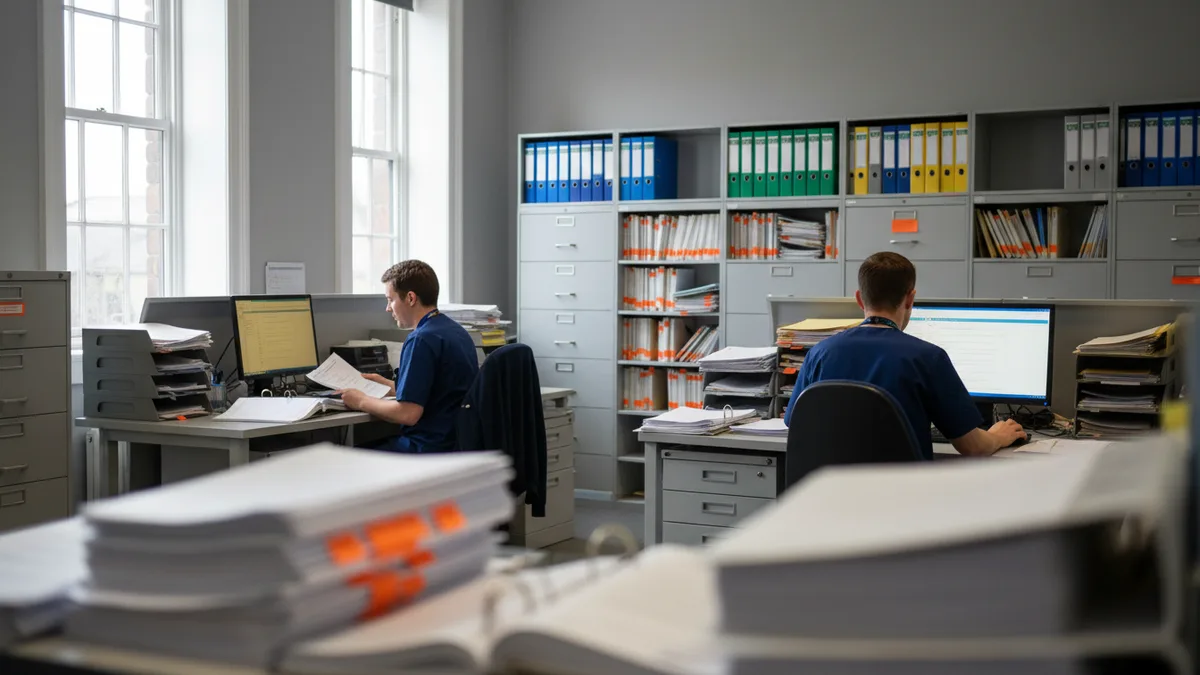
There is a particular kind of exhaustion that sets in when skilled, experienced people spend the majority of their working day on paperwork. A community care manager in Derry who knows every resident on her caseload by name, but spends three hours every Friday afternoon compiling handover reports from five different spreadsheets. A practice manager in Ballymena whose clinical staff are competent, motivated and chronically behind on their care plan documentation because the system for recording it was designed around a filing cabinet in 1994. The work is not hard in an intellectual sense. It is just relentless, repetitive and completely disconnected from the reason anyone came into this sector in the first place.
The conversation about AI in healthcare tends to go one of two ways. Either it becomes a grand vision about diagnostic algorithms and robotic surgery, which has nothing to do with running a care home in Antrim or a GP practice in Omagh, or it becomes a vague promise about chatbots that turns out to mean a public tool you would never trust with a patient record. Neither is useful. What is useful is a much more grounded question: which specific administrative and compliance tasks in your organisation eat the most time, carry the most risk if they go wrong, and could be handled faster and more accurately by a private AI system that never touches a public server?
What the admin burden actually looks like on the ground
Across Northern Ireland, health and social care organisations run on a combination of legacy software, shared drives full of Word documents, paper care plans, email threads that substitute for case management and spreadsheets that one person built three years ago and nobody fully understands anymore. The Health and Social Care Board, the Regulation and Quality Improvement Authority, the Care Inspectorate and the various commissioning bodies each have their own reporting requirements, their own formats and their own submission schedules. Keeping up with all of it, while also managing rotas, handling referrals, responding to families and supporting staff, is genuinely difficult.
The documentation burden is not abstract. A domiciliary care provider covering the greater Belfast area might have forty care workers completing daily notes across a dozen different client addresses. Getting those notes into a format that satisfies an RQIA inspection, while also feeding the information that managers need to spot deteriorating clients early, is a significant piece of work. Most organisations do it manually, slowly and imperfectly. The notes sit in a system, or worse in paper files, and nobody has time to read them systematically until something goes wrong.
Why this matters specifically for Northern Ireland
Northern Ireland has a distinctive set of pressures. The integrated health and social care structure, the ongoing workforce shortages, the geography of rural areas like Fermanagh and the Glens of Antrim where community care teams cover large distances, and the particular legacy of a public sector that is large relative to the private economy: all of these shape what admin pressure looks like here.
Private and voluntary sector care providers in Northern Ireland often operate on thin commissioning margins with no slack for inefficiency. A small residential care home in Cookstown cannot afford a dedicated compliance officer. The registered manager is doing the compliance work alongside everything else. When an inspection is announced, the scramble to pull together evidence, policies, supervision records and care plan audits is enormous. That is not a management failure. It is a structural one, and it is exactly the kind of problem a well-built private AI system can help with, not by replacing judgement, but by doing the retrieval, summarisation and formatting work that currently falls on the most experienced person in the building.
There is also a data sensitivity dimension that matters more here than in almost any other sector. Patient and service user records are among the most confidential documents any organisation holds. The idea of uploading them to a public AI tool to get a summary or draft a report is not just inadvisable, it is a potential breach of data protection law and a serious regulatory risk. Private AI, installed inside your own infrastructure and connected only to your own systems, removes that risk entirely. The data stays where it belongs.
Where AI is already making a practical difference in care settings
Document and knowledge search is the most immediate win for most care organisations. Imagine being able to ask a question in plain English and get an answer drawn from your own policies, procedures, care plans and inspection reports, with the source document cited. A deputy manager preparing for a supervision meeting could pull up the last six months of notes on a specific member of staff in thirty seconds. A manager responding to a complaint could retrieve every relevant entry from a resident's care record without manually searching through a filing system.
Automated reporting is the second area where the time savings are measurable quickly. If your care workers are completing daily notes in a digital system, a private AI application can read those notes, identify patterns, flag anything that suggests a change in a client's condition, and produce a structured weekly summary for the manager, without anyone having to read every entry individually. The same logic applies to mandatory returns, monthly compliance reports and board packs. The AI drafts from the data that already exists in your systems. A human reviews and approves. The process that took four hours takes forty minutes.
Compliance and policy management is a third area. Care organisations accumulate policies the way attics accumulate boxes. Many are out of date, some contradict each other and nobody is quite sure which version is current. A private AI system can index all of them, flag documents that have not been reviewed within a defined period, and help managers quickly check whether a specific procedure is covered and where. Before an RQIA inspection, that kind of organised, searchable evidence base is genuinely valuable.
What to be realistic about
AI does not replace clinical judgement, safeguarding decisions or the human relationship at the centre of good care. It should not be positioned as doing so, and any supplier who suggests otherwise is selling you something you do not want. The value is in the administrative layer: the documentation, the retrieval, the formatting, the pattern-spotting in structured data, the drafting of reports that a human then reads and signs off.
It is also worth being clear that a care organisation with chaotic, incomplete or inconsistent data will not get clean outputs from an AI system. If daily notes are sparse and inconsistent, automated summaries will reflect that. Part of an honest implementation process is looking at the quality of the data that already exists and deciding whether process improvements need to happen alongside the AI work. That is not a reason to delay, it is a reason to start with a scoped audit rather than a big deployment.
Finally, staff buy-in matters. Care workers who have been through multiple rounds of new systems that made their jobs harder, not easier, are right to be sceptical. The AI tools that stick are the ones that visibly reduce the admin burden on the people doing the work, not just the people managing it. A good implementation starts by asking frontline staff where the friction is, not by telling them what the technology can do.
Where to start if you run a care or health organisation in Northern Ireland
The most useful first step is not buying anything. It is getting a clear picture of where admin time actually goes across a typical week, which compliance deadlines cause the most pressure, where information gets lost or duplicated between systems, and which tasks are repetitive enough that a well-trained AI application could handle the first draft.
A structured AI Discovery process does exactly that. It maps your current systems and data, identifies the two or three processes where AI would have the clearest impact, and produces a costed plan so you know what you are committing to before anything is built. For a care home or a GP practice, that first application might be a document search tool that covers your policies, care plans and inspection history. For a domiciliary care provider, it might be an automated daily notes summariser that feeds a weekly manager dashboard. The point is to start with one thing, prove it works and build from there.
The platform sits inside your own infrastructure. Your service user records, staff files and compliance documents never leave your control. Nobody else trains their models on your data. That is not a feature of a particular product. It is the only way this should work in a sector where confidentiality is not optional.
Want to see where AI could save your team the most time?
Book a free 30-minute conversation with Verona AI. We will look at the specific admin and compliance pressures in your practice or care organisation and show you what private AI, built on your own data, could realistically do first.
Book a free consultationMore from the Verona AI blog

Bill Every Hour, Miss Nothing and Stop Losing Margin to a Practice That Runs on Emails and Memory: Practical AI tools Northern Ireland accountants, solicitors and consultants can put to work right now
Northern Ireland professional services firms are losing time and margin to manual admin. Private AI built on your own data can change that fast.
The Potato Field That Learned to Talk Back: A quiet AI revolution in crop disease detection is saving harvests, cutting chemical use and giving small farms a fighting chance
A Feel Good Friday look at how AI is helping farmers detect crop disease earlier than ever, and what that spirit of practical innovation means for NI businesses.
Make More, Waste Less and Stop Losing Margin to a Factory Floor That Runs on Paper and Instinct: Practical AI tools Northern Ireland manufacturers, production managers and operations teams can put to work right now
Northern Ireland manufacturers: practical private AI for production, quality and reporting. Keep your data private and start with one measurable process.