Make More, Waste Less and Stop Losing Margin to a Factory Floor That Runs on Paper and Instinct: Practical AI tools Northern Ireland manufacturers, production managers and operations teams can put to work right now
Most Northern Ireland manufacturers are sitting on years of production data they never properly use. The problem is rarely the data. It is that no one has connected it to anything useful yet.
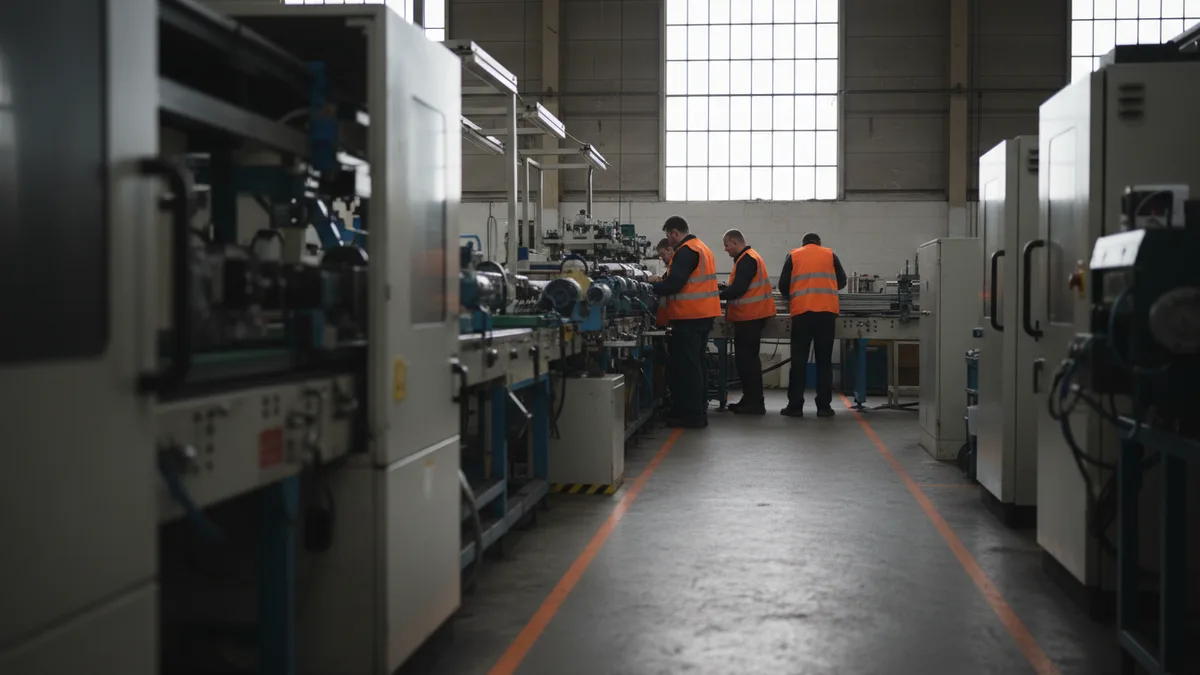
There is a particular kind of frustration that runs through almost every manufacturing business in Northern Ireland. The data exists. Shift logs, batch records, machine downtime reports, quality check sheets, supplier delivery notes, customer orders, stock movements. It is all there, somewhere, split across a production system that does not talk to the accounts package, a shared drive full of spreadsheets no one fully trusts, and a stack of paper job cards that someone types up on a Friday afternoon. The business runs, but it runs harder than it should.
The conversation about AI in manufacturing tends to go one of two ways. Either it sounds like something for the big German car plants, full of robots and six-figure software licences, or it gets reduced to a chatbot that answers questions from a website. Neither picture fits a mid-sized manufacturer in Ballymena, Newry or Antrim making components, food packaging, specialist textiles, or fabricated metalwork. What fits is something quieter and more practical: a private AI system that sits inside your operation, connects to the data you already have, and makes specific, measurable parts of the job faster and less prone to error.
Why this matters for Northern Ireland manufacturers
Northern Ireland manufacturing is not a single thing. It runs from large agri-food processors and aerospace sub-contractors to small precision engineering shops, plastics moulders, furniture makers and print businesses. What most of them share is a cost structure that leaves very little room for waste, a skills market that is tight, and a regulatory environment, particularly around food safety, product traceability and export documentation, that keeps adding paperwork without adding staff to handle it.
The dual-market position that Northern Ireland businesses occupy, trading into both Britain and the Republic, creates its own administrative load. Customs declarations, Rules of Origin documentation, supplier compliance checks and certificate management are not glamorous problems, but they consume real hours every week. In a business running on thin margins, those hours matter. The case for AI in manufacturing here is not about transformation for its own sake. It is about getting the margin back that is currently disappearing into admin, rework and decisions made on incomplete information.
There is also a competitive angle worth being direct about. Manufacturers in the Republic, in Britain and across Europe are starting to use private AI tools for production planning and quality management. The businesses that figure out how to use their own operational data well will quote faster, waste less and hold tighter tolerances. The ones that do not will find the gap widening, quietly, over the next two or three years.
Where production data goes to die
Walk into most manufacturing SMEs and you will find the same pattern. The ERP or MRP system holds some of the truth. The quality management system holds some more. The rest lives in spreadsheets on individual laptops, in email threads between the production manager and the buyer, in the maintenance engineer's notebook, and in the institutional memory of the people who have been there longest.
The problem is not that the data does not exist. It is that it is never in one place, it is never in a form that makes patterns visible, and by the time someone has pulled it together into a report, the moment to act on it has usually passed. A batch failed a quality check on Tuesday. By the time the non-conformance report is written up, reviewed and filed, it is Thursday. The root cause is already three production runs behind you.
A private AI system connected to your existing data sources changes that dynamic. It does not replace your ERP or your quality system. It sits alongside them, reads the data they produce, and surfaces the things that matter before they become expensive. That might be flagging that a particular supplier's material is correlating with higher rejection rates. It might be spotting that a specific machine is showing a pattern of micro-stoppages that precedes a longer breakdown. Neither insight requires new sensors or new software. It requires someone to have connected the data that already exists.
Document and traceability work that takes too long
Batch records, certificates of conformance, material traceability documents, customer-specific quality packs. For manufacturers supplying retailers, food businesses or aerospace customers, the documentation burden is substantial and the tolerance for error is low. A missing certificate or an incorrectly completed declaration can hold up a shipment, trigger a customer audit or, in a food context, result in a recall.
Much of this work is currently done by hand or by copying information between systems. Someone reads a batch record, extracts the relevant data, and types it into a customer template. That process takes time and introduces transcription errors. A private AI application built on your own document formats can read the source records, populate the output documents and flag anything that looks inconsistent, without the data ever leaving your business or touching a public AI tool.
For businesses dealing with cross-border documentation, the same logic applies. Rules of Origin calculations, supplier declarations, export health certificates. These are not complicated in concept but they are repetitive, they need to be right every time, and the cost of getting them wrong is disproportionate to the effort involved in doing them manually. Automating the routine parts of that work, while keeping a human in the loop for anything that needs a judgement call, is exactly the kind of application that delivers a measurable return quickly.
Production planning and demand that stops being a guessing game
Most production planning in an SME sits somewhere between a formal MRP run and the production manager's gut feel about what the week looks like. Both have their place. The MRP system is only as good as the data fed into it, and gut feel tends to be right more often than people credit, until it is not.
What private AI adds to this is the ability to work with patterns across a longer history than any individual can hold in their head. If you have three years of order data, production records and stock movements, there are seasonal patterns, customer-specific rhythms and demand signals in that data that are genuinely useful for planning. The question is whether anyone has the time to look for them. Usually, they do not.
A demand forecasting application built on your own order history, connected to your current open orders and your stock position, does not need to be perfect to be useful. If it reduces the frequency of emergency raw material purchases by a third, or cuts the number of times you are running a short production run to cover an unexpected order, the return is real and it is measurable. That is the kind of starting point worth building from.
Quality control and the cost of finding problems late
The economics of quality in manufacturing are straightforward and brutal. A defect caught at the incoming material stage costs almost nothing to fix. The same defect caught at final inspection costs significantly more. Caught by the customer, it costs more again, in returns, in credit notes, in the time spent managing the relationship and in the reputational damage that does not show up on a balance sheet but is very much real.
AI-assisted quality monitoring does not require you to replace your inspection process. It works by analysing the data your existing process already generates: inspection results, non-conformance records, machine parameters, operator notes. Over time it builds a picture of which variables are actually predictive of problems, which supplier batches tend to cause issues and which process conditions produce the best yield. That picture, surfaced in a simple dashboard rather than buried in a spreadsheet, gives your quality team something to act on before the problem has already happened.
For businesses making products to tight specifications, whether that is a food manufacturer hitting a fat content tolerance or a precision engineer holding a dimensional tolerance, the value of catching drift early is immediate. You are not just saving the cost of the failed batch. You are avoiding the downstream consequences that follow it.
Where to start
The right starting point is not a technology decision. It is a process decision. Pick the one thing in your operation that costs the most time, produces the most errors or creates the most friction between departments. For most manufacturers that will be something in quality documentation, production reporting or demand planning. Not all three at once.
A good AI Discovery engagement will spend time with your production manager, your quality lead and your finance team, map where the data actually lives, identify the two or three applications most likely to deliver a measurable return, and produce a costed plan you can take to your board. That is a very different thing from a software demo or a strategy presentation. It is grounded in your systems and your data, and it gives you a clear answer to the question of whether the investment makes sense before you commit to it.
The businesses in Northern Ireland that will use AI well in manufacturing are not necessarily the biggest or the most technically sophisticated. They are the ones willing to start with something specific, measure it honestly and build from there. The technology is ready. The question is whether the process you pick first is the right one.
Could your production floor run sharper with private AI?
Book a free 30-minute conversation with Verona AI. We will talk through where the real friction sits in your operation and show you what private AI built on your own data could do about it.
Book a free consultationMore from the Verona AI blog
Know What You Have, Know What You Need and Stop Losing Margin to a Warehouse That Runs on Yesterday's Data: Practical AI tools Northern Ireland wholesalers, distribution managers and buying teams can put to work right now
Northern Ireland wholesalers are losing margin to slow ordering, stock errors and disconnected systems. Here is how private AI changes that practically.
From Field to Invoice, Stop Losing Margin to a Food Business That Runs on Paperwork and Guesswork: Practical AI tools Northern Ireland food producers, processors and agri-food managers can put to work right now
Northern Ireland food and agri-food businesses are losing margin to manual admin, compliance paperwork and disconnected systems. Private AI can change that.
Quote Faster, Claim Smarter and Stop Losing Margin to a Site Office That Runs on Spreadsheets and Memory: Practical AI tools Northern Ireland contractors, estimators and project managers can put to work right now
Northern Ireland contractors are losing margin to slow quotes, missed variations and buried documents. Private AI can change that without exposing your data.