The Proof of Delivery Was Sent but Nobody Can Find It: What private AI can do for Northern Ireland hauliers and transport operators buried under driver records, PODs and compliance documents that pile up faster than any back-office team can manage
Every run generates paperwork. Tachograph files, proof of delivery, vehicle inspection sheets, operator licence conditions. Most of it sits in folders nobody searches until something goes wrong. There is a better way to run the back office.
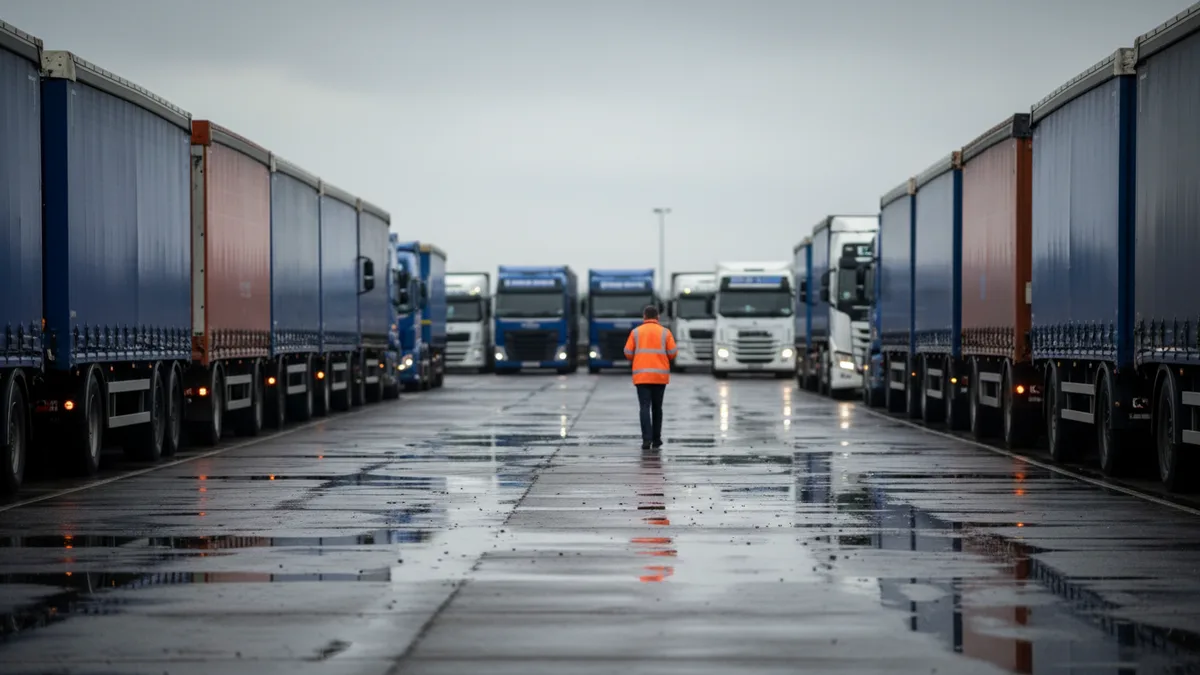
A haulage business running thirty vehicles out of, say, Newry or Antrim will process somewhere between two hundred and four hundred documents on a busy week. Proof of delivery notes, driver defect reports, tachograph analysis files, vehicle maintenance records, customer rate cards, subcontractor invoices, DVSA correspondence, operator licence schedules. Some of it arrives as scanned PDFs. Some of it lives in spreadsheets the transport manager built years ago and now nobody else fully understands. Some of it is still paper, folded into a cab door pocket and handed over on a Friday afternoon.
The back office team, usually two or three people at most in an SME fleet, spends a disproportionate amount of its week not moving freight forward but hunting for things. A customer rings to dispute a delivery. Someone needs to pull the signed POD from six weeks ago. The traffic manager knows it was scanned, somewhere, but the folder structure has drifted over three years and the search tool on the shared drive returns forty results with similar names. This is not a technology failure in the dramatic sense. It is just the slow, grinding friction that comes when documents accumulate faster than any manual system can keep up with.
Why Northern Ireland transport operators carry a heavier compliance load than most
Running trucks on the island of Ireland has always involved a particular administrative complexity. Cross-border movements between Northern Ireland and the Republic bring customs and transit documentation into the mix alongside the standard operator licence requirements. Post-2021 that burden increased for businesses moving goods between Great Britain and Northern Ireland, with additional entry summary declarations, commodity codes and goods vehicle movement service notifications sitting on top of everything else.
A transport manager in Londonderry or Enniskillen is not just managing driver hours against EU tachograph rules and DVSA roadworthiness standards. They are also keeping an eye on customs paperwork, managing relationships with agents and brokers, and trying to make sure the right documentation reaches the right customer at the right time. When a consignment is queried at a port, the answer needs to come in minutes, not hours. Most back-office setups are not built for that speed.
None of this is a complaint about the businesses themselves. They are well run, experienced operations. The problem is that the tools available to them, generic document management software, shared drives, email archives, off-the-shelf TMS platforms, were not designed to work together or to give a quick plain-language answer to the question: show me everything connected to this vehicle, this driver and this customer from the last ninety days.
What the paperwork mountain actually costs
It is worth being specific about where the time goes, because the cost is real even if it rarely appears as a line on the P and L. A transport administrator spending forty-five minutes locating a disputed POD, cross-referencing it with the driver debrief sheet and the customer invoice, and then drafting a reply to the customer is not unusual. Do that three times a week and you are looking at well over a hundred hours a year on one type of query alone.
Driver hours compliance is another pressure point. Tachograph data has to be downloaded, analysed and filed. Infringement reports have to be reviewed, discussed with drivers and documented. If the DVSA calls for a compliance audit, the operator needs to produce records quickly and in good order. Businesses that manage this manually, or through a standalone tachograph analysis tool that does not talk to anything else, often find that pulling together a coherent compliance picture for an audit takes days rather than hours.
Then there is the cost of things going wrong. A missed renewal on a trailer inspection, an overlooked licence condition, a subcontractor who has been used without a current goods in transit insurance certificate on file. These are not exotic failures. They happen in well-run businesses because the volume of documents is simply too high for manual tracking to catch every expiry date, every condition and every gap.
Why this matters specifically for Northern Ireland
Northern Ireland has a dense and capable transport and logistics sector. Businesses here serve the all-island market, the GB landbridge, and increasingly direct European routes through Dublin and Belfast ports. The sector ranges from single-vehicle owner-operators to fleets of several hundred trucks, with a significant cluster of mid-sized family businesses in the thirty to one hundred and fifty vehicle range that are substantial enough to carry real compliance risk but not large enough to have a dedicated compliance department.
That mid-market is where the document problem bites hardest. A business of that size will have a TMS, probably an accounts package, possibly a separate tachograph system, and a shared drive or cloud storage that has grown organically over years. These systems do not talk to each other. Nobody has a single view of a vehicle, a driver or a customer across all of them. The answer to almost any operational question involves opening three or four different systems and doing the joining-up manually.
There is also the workforce dimension. Experienced transport managers and administrators are not easy to replace. When the person who knows where everything is takes a holiday, or leaves, the institutional knowledge gap becomes visible very quickly. A private AI system that is connected to the actual documents and data in the business, not a public tool that knows nothing about your customers or your fleet, can make that knowledge far more accessible to everyone in the team.
What private AI can actually do in a transport back office
The starting point for most transport operators is document search and retrieval. A private AI platform installed inside the business, connected to the shared drive, the TMS export files, the scanned POD archive and the email history, can answer a plain-language question in seconds. Which PODs are outstanding for this customer this month? Show me all the defect reports for this vehicle in the last six weeks. What are the current operator licence conditions and when is the next review date? These are not complicated questions. They are just slow to answer manually when the documents are spread across multiple locations.
Beyond search, there is a strong case for automated compliance monitoring. The system can track expiry dates across the fleet, driver licence checks, vehicle MOT and inspection schedules, goods in transit insurance renewals, and operator licence undertakings, and flag anything approaching a deadline without anyone having to maintain a separate spreadsheet to do it. It can also pull together a compliance summary for a specific vehicle or driver on request, which makes audit preparation considerably less painful.
For businesses processing high volumes of inbound customer orders and rate queries by email, AI-assisted document processing can extract the key details, match them against existing rate cards and customer records, and draft a response or create a job entry in the TMS, reducing the manual keying that currently sits between the inbox and the system. This is not about replacing the traffic office. It is about removing the repetitive, low-value data entry that slows everyone down.
Where to start if you run a Northern Ireland fleet
The right starting point is almost never a big technology programme. It is one process that is clearly painful, clearly measurable and clearly worth fixing. For most transport operators that tends to be one of three things: disputed POD resolution, compliance document retrieval for audits, or expiry date tracking across the fleet.
Pick the one that costs the most time or carries the most risk right now. An AI Discovery engagement with Verona means a structured audit of that process, the systems and data involved, and a costed, ranked plan for what a private AI application could do about it. The commercial data stays inside your business throughout. Nothing goes into a public AI tool. The platform connects to the systems you already have rather than asking you to replace them.
A realistic first application for a thirty to fifty vehicle fleet could be up and running within a few weeks of the Discovery stage completing. The goal is not transformation for its own sake. It is a back office that can answer the question in front of it, quickly, without three people opening different systems to find the answer.
The broader point about keeping data private
Transport businesses hold commercially sensitive data that they cannot afford to expose. Customer rate cards, lane pricing, subcontractor agreements, driver personal data and vehicle utilisation figures are all information that competitors, customers and regulators would find interesting. Putting that data into a public AI tool, even inadvertently, is a risk that most operators would not accept if they thought carefully about it.
A private AI system addresses this directly. The model runs inside the business or in a private cloud environment. The data never leaves the operator's control and is never used to train any external model. The compliance and audit trail stays intact. For a sector where trust and confidentiality are part of the commercial relationship with every customer, that matters as much as the efficiency gains.
Could your transport back office run faster on your own data?
Book a free 30-minute conversation with Verona AI. We will look at where the paperwork pressure is greatest in your operation and show you what private AI, built on your own data and systems, could realistically do about it.
Book a free consultationMore from the Verona AI blog
The Pallet Left on Time but the Paperwork Did Not: What private AI can do for Northern Ireland cold chain operators buried under temperature logs, customer specs and compliance records that nobody can find at the wrong moment
Northern Ireland cold chain operators face daily battles with temperature records, compliance paperwork and customer specs. Private AI can change that fast.
The Stock Was There on Tuesday: What private AI can do for Northern Ireland retailers and online sellers buried under supplier data, customer queries and inventory decisions that never quite add up
Northern Ireland retailers waste hours chasing stock data, answering repeat queries and second-guessing orders. Private AI fixes the root cause, not the symptom.

The Hospital That Taught Itself to Listen: A small clinic in rural Bangladesh used AI to read patient records it could barely store. The ripple from that story reaches further than you might think.
A Bangladeshi rural clinic used private AI to make sense of fragmented patient records and cut missed diagnoses. A Friday story worth reading.